


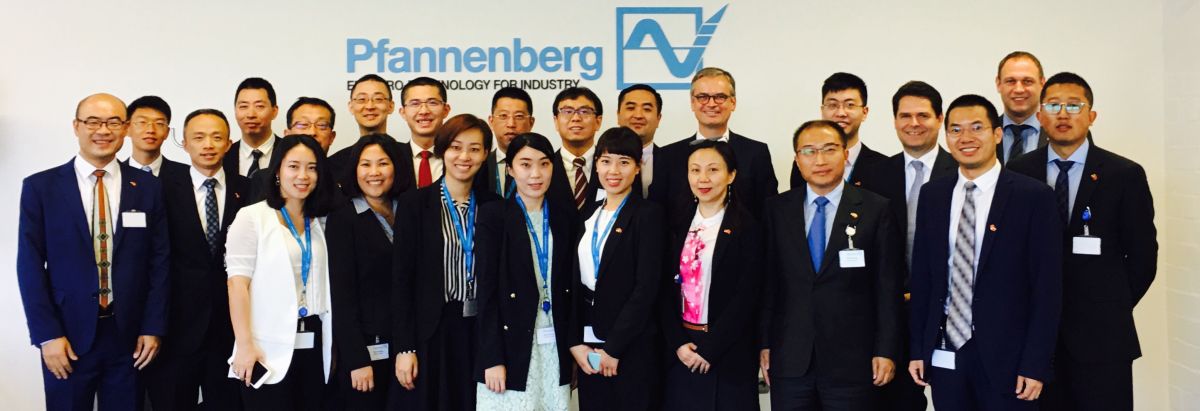
China’s domestic industry is currently undergoing a transformation. As part of its “China Manufacturing 2025” campaign, the government is facilitating Chinese businesses in setting up smart factories. Consequently, 20 SME executives from China who completed a four-week programme in Hamburg during the summer of 2017 showed enormous interest in discovering how German companies have embraced today’s shift towards Industry 4.0. Especially in view of the fact that, according to some participants, it is difficult for Chinese SME in this environment to tap into state subsidies.
Germany offers, in contrast to China, only very limited subsidies aimed at transitioning to Industry 4.0. On balance, the German federal government has provisioned up to EUR 200 million as part of its High-Tech Strategy 2020 action plan. With investments in excess of EUR 2.5 billion – just for the ongoing technological development of embedded systems – the GTAI asserts that it is companies themselves that shoulder the majority of work associated with transitioning to Industry 4.0.
Given this backdrop, the executives from China were keen to discover how German companies succeed in being leaders in innovation when it comes to Industry 4.0. During one of the first company tours, Jan Möbius, CEO of Pfannenberg GmbH, explained to the Chinese visitors how his company aligns innovation in production technology with the needs of customers. Pfannenberg invites important customers to a round table event twice a year. Discussions held during different sessions focus on new trends, current issues and desirable innovations. These events enrich the management team at Pfannenberg with plenty of new impetus for the development of new technologies, which are tailored to the needs of its customers. By way of example the company has collaborated with Telekom, the German telecommunications provider, to produce the first cloud-enabled solutions for industrial air conditioning. Benefits for the customer include the option of global control, a high degree of device efficiency, realistic maintenance planning and automated services.
During a visit to NXP Semiconductor another aspect of Industry 4.0 was brought to attention. Namely, when implementing networked production, data security must be given due consideration. This topic took centre stage in a presentation by Lars Reger, CTO of NXP Automotive, in addition to the current trends on autonomous driving. NXP has, for a number of years, been developing chips for use in both German and Chinese digital passports. These technologies must fulfil the highest security standards. And that's how it should be in the smart factory. All data should be able to be viewed via cloud solutions, and machines controlled remotely. It is, of course, of critical importance that only authorised individuals gain access to the data and machines. Hacker attacks could otherwise quickly unleash severe damage. The task faced by political administrations across the globe is to create a set of unified, high-level security standards.
“The term Industry 4.0 encompasses many different technologies” – this was the conclusion of the MP participants while delivering their assessment of the programme. “And by no means is there a one-size-fits-all approach to establishing a smart factory. Far rather, in Germany it's the customer’s needs that set the music – to which the suppliers of networked production technologies have to dance.”
By Timo Tekhaus
Akademie International, Hamburg
www.akademie.international