


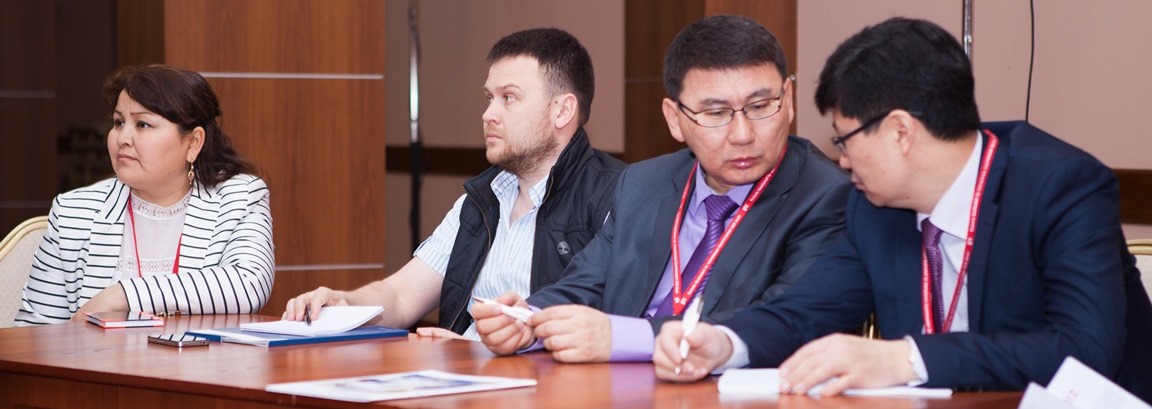
Energy efficiency is a highly topical subject in the countries of Central Asia. Thus, a workshop on this subject was right at the top of the wish list of Central Asian alumni of the BMWi training programme which took place in Tashkent, the capital of Uzbekistan. Particularly the European EUREM Training Programme met with keen interest on the part of the executives.
Tashkent. “Wheezing and hissing are an unmistakable sign that valuable energy is escaping due to leaks in the compressed air system and there is a need for energy-related optimisation.” “Yes, compressed air is a clean and safe energy carrier!“ “No, electrically driven machinery is less expensive.” There was fierce discussion during the workshop on energy-efficient technologies in industry. The participants – MP alumni and executives with special knowledge from industrial companies, but also from universities and trading organisations – came from Kazakhstan, Uzbekistan, Kyrgystan and Turkmenistan. They learnt not only how energy audits according to ISO 50001 are to be carried out and how efficient energy management can be organised but also what components are important for the various cross-cutting technologies in industrial applications. What are the greatest energy consumers in compressed air systems, lighting systems and air-conditioning systems and when is the use of heat recovery systems sensible?
In the process, it became clear that there are considerable differences within the Central Asian states regarding the level of knowledge and experience in the implementation of measures to improve energy efficiency. Industrial energy intensity is high in these countries. Many Central Asian countries have large resources of traditional energy carriers (petroleum and gas in Kazakhstan, Turkmenistan and Uzbekistan; hard coal in Uzbekistan and Kazakhstan). At the same time, conditions are good for the utilisation of alternative energy sources – hydropower in Kyrgyzstan and photovoltaic (with more than 300 hours of sunshine per year) and wind power in the whole of Central Asia. However, the laws and regulations on the implementation of measures to improve energy efficiency are just as varied as the natural resources and the level of development in the individual countries. Kazakhstan is taking a lead in the region. The Law on Energy Saving and Increasing Energy Efficiency has been in force since 2012 and the Energy ‘Efficiency 2020’ programme since August 2013. The government decision of 31.08.2012 regulates the procedure for the organisation and carrying out of energy audits but does not stipulate a clear method. The introduction of an energy management system according to ISO 15001 is binding for companies with an annual energy consumption exceeding 1500 tonnes of coal equivalent.
In neighbouring Uzbekistan, on the other hand, there has been a Law on Rational Use of Energy since 1997 and a national energy efficiency plan since 2001. Uzbekistan is the most populous country in Central Asia and the largest energy consumer in the region. However, no legal obligations on energy saving exist so far. But the Uzbek government is interested in improving energy efficiency in the country in order to increase the proportion of natural gas exported. UNDP and the World Bank are currently developing the ‘Vision 2030’ strategy, a transformation concept for the Uzbek economy regarding sustained economic activity and sustained growth, on behalf of the Uzbek government.
In addition, the basic infrastructural conditions differ considerably in the individual countries. In some rural regions of Uzbekistan – host of the conference – there are e.g. numerous small and medium-sized textile factories which their managers would be glad to retrofit with modern technologies. Due to the poor condition of the power distribution and power supply infrastructure, power failures are not seldom, and there is often no gas supply in these regions.
Decisions on investments are therefore based on several criteria. In this region, it is not sufficient to concentrate on return on investment (ROI), the most important criterion in Germany, when deciding on the implementation of energy efficiency projects. Neither in Kazakhstan nor in Uzbekistan is there a regulation regarding top income tax, i.e. investments there will not pay for themselves through quick tax savings. Furthermore, the legally regulated electricity price is still low to avoid social unrest during the transformation. Thus, the payback period for savings in electricity consumption is fairly long. The lack of investment incentives is one of the most important reasons why, up to now, specific investment projects have only been implemented – if at all – through EU or other support programmes. Another reason is the lack of specialists on the spot for the new technologies.
EUREM Training Programme
The Central Asian executives were particularly interested in the European EUREM Training Programme, which was introduced at the workshop. This programme is already carried out in 30 countries; in Germany it is provided by selected chambers of commerce and industry. Technical and commercial topics around energy-efficient technologies, energy audits and the development of an efficient corporate energy management system are imparted in 160 training sessions over a period of nine months. A project thesis prepared in the participant’s company serves to prove the participant’s ready-to-apply knowledge.
It very soon became clear: “We also want a training initiative like this one which provides future energy managers in companies but also energy consultants with the necessary technical, economic and specialist skills, and we want to apply for financing via the KfW. And we would like to know more about how high-quality energy audits are carried out.”
During the workshop, the Kazakh scientist Georgij Nikonov from GN Energy presented a patented technology developed in Kazakhstan for the non-destructive measurement of the temperature during the melting process, e.g. in blast furnaces and foundries. This enables improved control and supervision of the entire melting process without interrupting the production. Technologies like this are used, for instance, to keep the wall thickness of the inner lining in blast furnaces and melting furnaces as low as possible, which considerably reduces the expenditure of energy needed for melting. GN Energy is still looking for investors for the technical implementation of the Kazakh patent.
At the workshop, it also became clear that the strong interest in the topic of energy efficiency also resulted from the fact that several participants are planning to become energy consultants or energy managers themselves.
By
Kathrin Kehrer-Billhardt, an independent expert providing consulting services within the German power sector and in the field of energy efficiency, is a 2008 alumna of the programme ‘Fit for Business with Russia’