


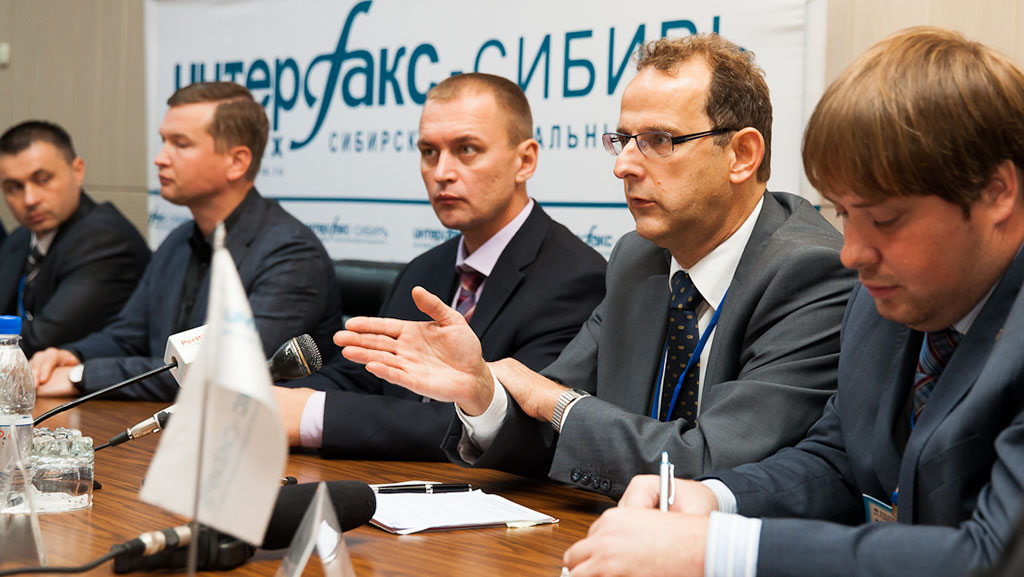
German executives travelled to Siberia for what was already the third time to learn more about an exciting, growing market and to establish contact with Russian companies. However, before flying east, the German business people first had to return to school. The GIZ taught them all about the country and its people. For “Good preparation is essential”. Sinan Sat from the leading German newspaper, the Westdeutsche Allgemeine Zeitung (WAZ), accompanied the German delegation. A travel report.
Markus Szirmay straightens his tie and smooths down his jacket. He didn’t get much sleep last night and is a little tired. There’s no time to rest now though. Szirmay has a date. Indeed, if everything goes to plan, it will be the first of many. He takes a deep breath, focuses and enters the large conference room of a hotel in Novosibirsk. Fifty men and women sit in rows with catalogues spread out in front of them, waiting for the event to begin. Buyers and sellers, producers and service providers, meat manufacturers and guitar retailers from Germany and Russia are meeting here for a speed dating session. They have 15 minutes to convince their conversation partner of their product before moving on to the next table. Szirmay has travelled thousands of miles to participate in this event. He knows that first impressions are crucial. The German entrepreneur is well-prepared: he participated in a three-day seminar on Russia beforehand and has familiarised himself with the Russian corporate culture. He greets potential business partners in Russian.
The qualified engineer wishes to sell industrial fans in Siberia. He knows the Siberian market. In 2010, he was one of the first German entrepreneurs to participate in the Manager Training Programme aiming to improve trade relations between Germany and Siberia. Sixty-five German entrepreneurs have since visited Siberia alone – 300 in total across the entire country. Around 70 per cent of the companies to participate in the programme have enjoyed long-term business relations with Russian partners ever since.
Growth opportunities in Siberia
“Particularly Siberia harbours huge growth potential for cooperation between German and Russian companies. In the past, the focus of German industry was not really on the east of Russia that is rich in raw materials, but this is gradually changing,” confirms Olga Kolesova, who organises the training programme in Siberia on behalf of the Russian government.
Kolesova seems pleased. The last of ten dating rounds is just coming to an end. Hundreds of business cards have been exchanged and around 200 discussions conducted. In a few months’ time, the Russian will inquire how many business deals were ultimately concluded. Last year, around 20 contracts were signed after the contact forum.
Markus Szirmay is also pleased. “Not all of the companies of interest to me were present, but I still had a few good discussions. I have a good feeling with one of them. I think they will contact me soon,” the 50-year-old predicts. He wants to suggest recruiting new staff, who are familiar with the country and language, for sales in Russia to his company’s management team upon his return. After all, he learned in the preparation seminar how highly Russian business people value having a direct contact with whom they can build a relationship of trust. “That’s where we have fallen down in the past,” Szirmay says.
Benefit from the experience of others
He loosens his tie and scans the programme. The German delegation will visit the window frame manufacturer Veka Rus next. The company has its headquarters in Sendenhorst in North Rhine-Westphalia. Since 2004, Veka has also produced in Novosibirsk though. “For logistical regions, the location was an ingenious decision reached by company management,” explains site manager Andrei Yermakov. “As the market leader, we deliver to the entire east of Russia from here.” The lawns outside the gates to the modern company building are neatly mown and the German and Russian flags flutter in the mild Siberian late summer breeze. On the other side of the road is a vast industrial complex with smashed windows. The building looks like nothing has been manufactured there since long before the fall of the Soviet Union. The building is actually used by a Russian company that manufactures fodder for pigs. Yermakov is aware of the stark contrast and the thoughts and doubts they raise in the German entrepreneurs. “Cleanliness, order, safety – all in line with the German role model,” he states without even being asked, and invites the German entrepreneurs on a two-hour tour of Veka Rus. When the two hours are over, they are all convinced. The German company’s investments have been worthwhile. The plant featuring machines “Made in Germany” operates efficiently. “You shouldn’t be put off by the surrounding area. Good, efficient production is clearly also possible in Siberia,” one German entrepreneur concedes.
Contact with decision-makers
The delegation boards the bus again. They are expected at their next meeting. The governor of the Novosibirsk region, Vasily Yurchenko, has invited them. “These are advantages that only this programme can bring,” tells Alex Renner, who is participating in the training on behalf of a German consulting firm. “You meet decision-makers from the fields of politics and business that it would not be as easy to come into contact with otherwise, and good contacts are the be-all and end-all in business.”
On the way to the government building, Markus Szirmay receives an email. His conversation partner from earlier in the day with whom he said he had a “good feeling” wishes to know more about the industrial fans. The German is pleased.
After the meeting with the governor, Markus Szirmay returns to his hotel. Another long day lies ahead of him and the other entrepreneurs tomorrow. Some will travel to Altai, a region characterised by mechanical engineering and agriculture; others to Tomsk, which is rich in mineral oil and natural gas. Szirmay will visit the mining region of Kemerovo, where the engineer believes he will be able to find people interested in his industrial fans.